Thyroid
Butterfly-shaped gland regulating metabolism and calcium balance.

Mikael Häggström , M.D. Author info - Reusing images - Conflicts of interest: No · CC0
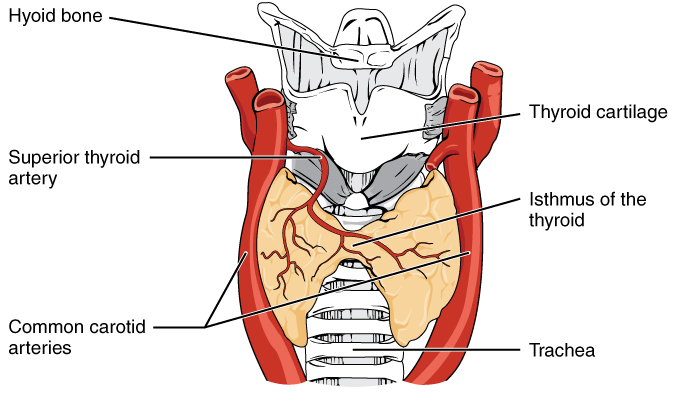
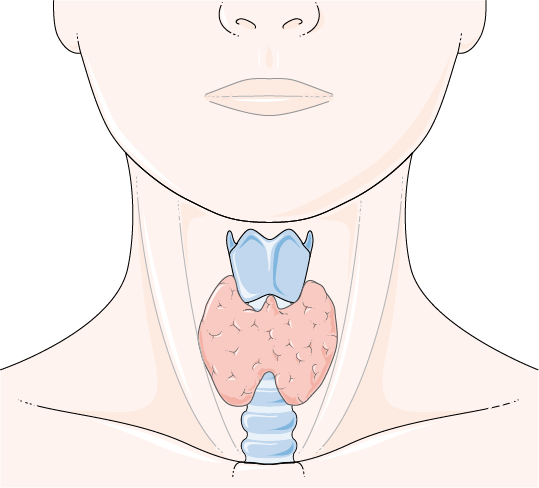
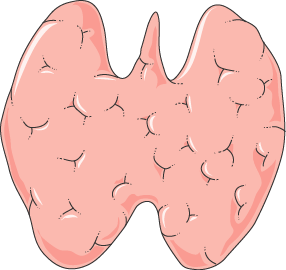
The thyroid, or thyroid gland, is an endocrine gland in vertebrates. In humans, it is a butterfly-shaped or H-shaped gland located in the neck below the Adam's apple. It secretes three hormones: triiodothyronine (T3), thyroxine (T4), and calcitonin, which influence metabolic rate, protein synthesis, growth, development, and calcium homeostasis.
- type
- Endocrine gland
- location
- Neck, below the Adam's apple
- weight
- 25 grams in adults
- hormones_secreted
- T3, T4, calcitonin
- functional_unit
- Thyroid follicle
- common_disorders
- Hyperthyroidism, hypothyroidism, thyroiditis, goitre, nodules, cancer
Lore & Background
Thyroid disorders include hyperthyroidism (often from Graves' disease), hypothyroidism (often from iodine deficiency or Hashimoto's thyroiditis), thyroiditis, goitre, nodules, and cancer. In iodine-deficient regions, hypothyroidism is the leading cause of preventable intellectual disability in children. Anatomical variants include a pyramidal lobe (Lalouette's pyramid) and Zuckerkandl's tubercle.
Reader's Guide
The thyroid gland is a central regulator of metabolism and growth in vertebrates. Its hormones, T3 and T4, control metabolic rate and are critical for development in children. Calcitonin contributes to calcium homeostasis. The gland's function is tightly controlled by the hypothalamic-pituitary-thyroid axis. Disorders of the thyroid are common and have significant health impacts: hyperthyroidism accelerates metabolism, while hypothyroidism slows it, and iodine deficiency remains a major cause of preventable intellectual disability worldwide. The gland's anatomy, including its blood supply and relationship to the recurrent laryngeal nerve, is important in surgical procedures. The discovery of its microscopic structure, including follicles and parafollicular cells, has deepened understanding of endocrine function.
Did You Know?
- The thyroid gland weighs about 25 grams in adults and is usually larger in women than in men.
- The pyramidal lobe, a third lobe present in 18.3% to 44.6% of people, is a remnant of the thyroglossal duct.
- The most common cause of hyperthyroidism is Graves' disease, an autoimmune disorder.
- In iodine-deficient regions, hypothyroidism is the leading cause of preventable intellectual disability in children.
The Body in Overdrive: Clinical Presentation
Hyperthyroidism can range from entirely silent to profoundly disruptive. The surplus thyroid hormone essentially overdrives the metabolic engine and derails the sympathetic nervous system, producing a cluster of symptoms that closely resemble an adrenaline overdose. Patients may report a racing heart, palpitations, hand tremors, anxiety, irritability, and trouble sleeping. The gut speeds up, bringing frequent bowel movements and diarrhea, while appetite paradoxically increases. Weight loss is common and can be dramatic, though roughly one in ten affected individuals actually gain weight. Skin thins, hair turns fine and brittle, and muscles weaken, especially in the upper arms and thighs. Women may notice lighter, less frequent menstrual cycles. In Graves' disease specifically, swollen eye muscles can push the eyes forward, and a visible neck swelling from an enlarged gland may appear. Crucially, these hallmark signs are often muted or absent in elderly patients, making the condition harder to recognize in older adults.
Tracing the Source: Causes and Diagnostic Pathways
In the United States, Graves' disease is responsible for roughly half to four-fifths of all hyperthyroidism cases. Other identifiable causes include multinodular goiter, toxic adenoma, thyroid inflammation, excessive iodine consumption, and overuse of synthetic thyroid hormone. A rarer culprit is a pituitary adenoma. Diagnosis typically begins with clinical suspicion drawn from the patient's presentation, then moves to blood work. The characteristic laboratory finding is a suppressed thyroid-stimulating hormone alongside elevated T3 or T4. To pinpoint the underlying etiology, clinicians may order a radioiodine uptake test, a thyroid scan, or measure antithyroid autoantibodies. In Graves' disease, thyroidal thyrotropin receptor antibodies return positive, helping separate it from other forms. The boundary between hyperthyroidism and the broader term thyrotoxicosis is sometimes blurred in everyday clinical language, though technically thyrotoxicosis encompasses any source of elevated thyroid hormone, not just overproduction by the gland itself.
Three Roads to Recovery: The Treatment Landscape
Management is tailored to the underlying cause and severity, with three principal pathways available. Radioiodine therapy involves the patient ingesting iodine-131, which the thyroid concentrates and which gradually destroys the gland over weeks to months; the predictable resulting hypothyroidism is then managed with daily synthetic hormone. Pharmacological approaches include beta blockers to tame sympathetic symptoms and anti-thyroid drugs such as methimazole, which can provide temporary relief while definitive treatments take hold. Surgical removal of the thyroid remains an option for patients with very large glands or when malignancy is a concern. An uncommon but devastating complication is thyroid storm, in which a trigger such as infection precipitates catastrophic worsening—confusion, extreme hyperthermia—and frequently proves fatal. After a euthyroid state is restored, most patients see anxiety, fatigue, and irritability resolve within one to two months, though a subset may carry residual cognitive or affective symptoms for months or even up to a decade.
The Long Shadow: Complications and Who Is Affected
Epidemiology reveals a strong gender and age pattern: hyperthyroidism strikes women two to ten times more often than men, with onset typically between ages 20 and 50, though prevalence climbs with age and the condition is most common in those over 60. In the United States, about 1.2% of the population is affected, while the global figure reaches 2.5% of adults. Left untreated, the disease carries serious long-term risks. Overt hyperthyroidism—distinct from the subclinical form—drives accelerated bone remodeling and density loss, raising fracture risk in 10 to 20% of patients, a danger that hits postmenopausal women hardest. This skeletal damage was first documented by Frederick von Recklinghausen in 1891, who described the skeleton of a deceased patient as looking "worm-eaten." Cardiovascularly, patients face abnormal rhythms, notably atrial fibrillation, along with shortness of breath. Neurologically, tremors, myopathy, and in susceptible individuals of Asian descent, periodic paralysis can emerge. An autoimmune link to myasthenia gravis has also been recognized, with roughly 5% of myasthenia gravis patients also harboring hyperthyroidism.
Gallery
Frequently Asked Questions
Who is Thyroid?
Thyroid is a butterfly-shaped endocrine gland positioned in the neck just beneath the Adam's apple, weighing about 25 grams in a healthy adult. It is one of the body's principal hormone-producing organs.
What are Thyroid's powers/role?
Thyroid releases three hormones—T3, T4, and calcitonin—that control metabolic rate, protein synthesis, growth, development, and calcium homeostasis. Its basic working unit is the thyroid follicle, a small spherical cluster that stores and dispatches those hormones.
How does Thyroid's story end?
Thyroid's arc is frequently disrupted by conditions such as hyperthyroidism, hypothyroidism, thyroiditis, goitre, nodules, and thyroid cancer. Any of these can throw its hormone output out of balance and ripple through the rest of the body.
Why is Thyroid important?
Without Thyroid's hormonal signals, the body cannot properly set its metabolic speed, maintain calcium levels, or support normal growth and development. It essentially functions as the body's internal thermostat for energy expenditure.
What is Thyroid's functional unit?
The thyroid follicle serves as Thyroid's functional unit, a round, single-layered cell cluster that synthesizes, stores, and secretes T3, T4, and calcitonin into the bloodstream. Each follicle acts as a miniature production line for the gland's three key hormones.
More in Physiology & Medicine 1-19
Spotted an error? Know more?
This is a living reference — every entry is fact-audited, and reader corrections feed straight into our audit queue. Suggest an edit · See this site's audit record